There is a question we hear constantly from the managers, owners, and sales directors we work with: “How can I generate more bookings and leads without hiring more people or working longer hours?” The answer almost always involves the same tool: marketing automation.
This isn’t about impersonal robots or mass messages without context. Well-designed marketing automation does exactly what an expert salesperson would do: it reaches the right customer, at the right moment, with the right message automatically, at scale, and measurably. For hotels, restaurants, and real estate agencies in Bogotá, Medellín, Cartagena, Mexico City, Miami, and Orlando, this translates into bookings that arrive while the team sleeps, leads that nurture themselves until they’re ready to talk to sales, and customers who return without anyone having to call them. To understand how it fits within a broader strategy, the 4 basic elements of a marketing automation strategy are a fundamental starting point.
What marketing automation is and why it changes the game
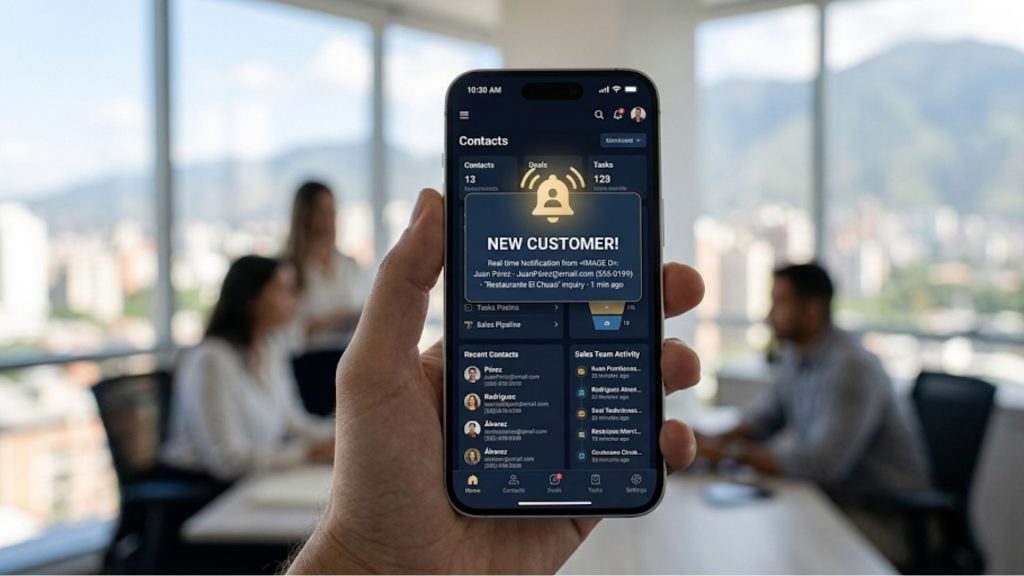
Marketing automation is the use of technology to execute communication and conversion actions automatically, based on the behavior, characteristics, or stage of the buying cycle each customer or prospect is in.
In simple terms: when someone visits your website without booking, they automatically receive a reminder email the next day. When a hotel guest checks out, they automatically receive a review request. When a real estate prospect downloads an investment zone guide, a sequence of educational emails begins that nurtures them about the project over the following weeks. All of this happens without manual intervention, 24 hours a day, 7 days a week.
The concrete benefits for hospitality and real estate businesses are:
1. More conversions with the same team Automation multiplies the team’s capacity without increasing headcount. A hotel with 3 people in reservations can respond, nurture, and close like one with 10 if its automated flows are well designed.
2. Response speed that converts 78% of buyers choose the provider that responds first. With automation, the initial response arrives in seconds not hours dramatically increasing the conversion rate of incoming leads.
3. Personalization at scale A well-segmented automatic message can be more relevant than a generic manual one. Automation allows sending the right message based on the room type the user browsed, the property price range they explored, or the type of cuisine they searched for at the restaurant.
4. Effortless loyalty The customer who already knows you is the easiest to win back. Automated loyalty sequences birthday greetings, seasonal offers, anniversary reminders keep your brand present without constant manual effort.
5. Data and continuous learning Every automated flow generates data: which messages are opened, what gets clicked, what converts best. That data improves the strategy cumulatively over time.
Automation for hotels: from booking to loyal guest
For a hotel, the guest relationship cycle has multiple touchpoints before, during, and after the stay. Automation allows each one to be optimized without depending on the team’s memory or availability.
Before arrival: converting and preparing
- Booking abandonment recovery sequence: when a user checks availability but doesn’t complete the booking, they automatically receive an email and optionally a WhatsApp with a personalized reminder, the rate they saw, and an additional reason to book directly.
- Confirmation and pre-check-in: automatic confirmation emails with arrival information, available services, and the option to upgrade or add experiences (breakfast, spa, transfer), generating additional revenue effortlessly.
- Pre-stay upsell: between 3 and 7 days before arrival, automatic communications offering room upgrades, special packages, or local activities with high conversion potential because the guest is already in “travel mode.”
During the stay: experience and engagement
- Automated welcome: a WhatsApp or SMS message at check-in with useful information: WiFi code, restaurant hours, available services, and a direct communication channel with the hotel.
- Mid-stay satisfaction survey: 24 hours after arrival, a brief message that allows identifying and resolving issues before check-out, reducing negative reviews.
After the stay: reviews and loyalty
- Post-check-out review request: sent automatically between 2 and 6 hours after check-out, when the experience is still fresh, with a direct link to Google or TripAdvisor.
- Loyalty sequence: in the following months, automatic communications with return offers, hotel updates, or relevant content about the destination that keep the relationship alive and generate repeat bookings.
Automation for restaurants: filling tables on autopilot
For a restaurant, automation solves two major challenges: consistently attracting new diners and bringing existing ones back. Both are achievable with well-designed flows.
Acquisition and first booking
- Automated retargeting: users who visit your website or Instagram profile without booking automatically enter a remarketing audience that receives personalized ads over the following days.
- Automatic response to social media messages: when someone asks about availability in Instagram Direct or Facebook Messenger, they receive an immediate response with booking options, menu, and hours without anyone having to be behind the screen.
- Booking form with automatic confirmation: every online booking generates an instant email and/or WhatsApp confirmation with the details, reducing no-shows with an automatic reminder 24 hours in advance.
Loyalty and reactivation
- Birthday sequence: if the restaurant captures the birth date during the booking process, it can automatically send a special offer in the diner’s birthday month with a conversion rate that typically exceeds 30%.
- Inactive customer reactivation: diners who haven’t visited in 45 or 60 days automatically receive a message with a reason to return: a new dish, an upcoming event, or simply a “we miss you” with an incentive.
- Post-visit review request: sent automatically 2 hours after the reservation time, when the diner has just left and the experience is at its peak.
For a deeper look at how to implement these strategies in the specific context of the restaurant sector, the article on digital transformation in restaurants: from physical menus to automation offers a practical framework adaptable to different types of restaurants.
Automation for real estate agencies: nurturing leads for months without manual effort
The decision cycle in real estate can last between 6 and 18 months. Without automation, maintaining an active relationship with 200 leads at different funnel stages requires a large sales team. With automation, it’s possible to nurture all those leads in a personalized and consistent way automatically identifying when one is ready to talk.
Lead nurturing from first contact
- Post-form welcome sequence: when a prospect completes a contact form, they automatically receive a series of emails over the following 7 days that introduce the project, answer frequently asked questions, show buyer testimonials, and offer an advisory session.
- Behavior-based segmentation: if the prospect opens emails about 2-bedroom units but ignores those about 3-bedroom ones, the system automatically segments them and adjusts future content to their actual interest.
- New property alert: when a property enters inventory that matches the search profile registered in the CRM, the prospect receives an automatic notification being the first to know.
Lead scoring and sales team prioritization
With an automated lead scoring system, the CRM assigns points to each prospect based on their behavior: how many emails they opened, whether they visited the website, whether they downloaded the brochure, whether they scheduled and attended a visit. The sales team doesn’t call everyone equally: they concentrate their energy on the highest-scoring leads, optimizing time and closing rates.
Post-visit follow-up and closing
- Post-visit sequence: when a prospect visits a property, they automatically receive additional information within the next 48 hours: a comparison of the unit visited, testimonials from current owners, and an invitation to take the next step.
- Expiring offer reminder: if a prospect has a pending offer awaiting response, the system sends gradual automatic reminders without the advisor having to manually follow up every day.
Technology: which tools to use and how to integrate them
Marketing automation doesn’t require excessively complex or expensive technology. The most commonly used tools in Digisap’s projects for hotels, restaurants, and real estate agencies are:
- CRM: HubSpot, Salesforce, Zoho, or Pipedrive to manage leads, segment contacts, and activate automatic flows based on behavior.
- Email marketing: Mailchimp, ActiveCampaign, or Klaviyo for nurturing sequences, loyalty campaigns, and transactional communications.
- WhatsApp Business API: for automated confirmation, reminder, review request, and reactivation messages with a high open rate (90%+ vs. 20–30% for email).
- Integrated booking engine: for hotels and restaurants, integrating the booking engine with the CRM and email tools allows activating automatic flows based on real booking behavior.
- Meta and Google Ads with automatic audiences: Meta and Google tracking pixels create dynamic audiences that update automatically based on website behavior, activating automated retargeting without constant manual configuration.
The key isn’t using more tools it’s integrating them correctly so data flows between them and flows activate at exactly the right moment.
Case studies: automation that generates real results
Boutique hotel in Medellín: recovering abandoned bookings
A boutique hotel in El Poblado implemented an automatic booking abandonment recovery sequence: when a user checked availability but didn’t complete the booking, they received an email 2 hours later and another at 24 hours, with a reminder of the rate and a direct comparison with what the same night would cost on Booking.com including commissions. The sequence recovered 18% of abandonments, generating an average additional revenue of USD 3,200 per month without any additional advertising investment.
Restaurant in Miami: automatic loyalty that filled tables on Tuesdays
A restaurant in Coral Gables had high occupancy on weekends but empty tables Tuesday through Thursday. With an automatic reactivation sequence targeting diners who hadn’t visited in more than 30 days with an exclusive “Tuesday–Thursday executive menu” offer it grew occupancy on slow days by 27% in eight weeks, without changing its advertising budget.
Real estate agency in Bogotá: lead scoring that tripled sales team productivity
A real estate agency with 340 active leads in its CRM implemented an automated lead scoring system. Before, the team called all leads in order of entry; after, they concentrated 80% of their time on the 20% of leads with the highest score. In three months, the lead-to-visit conversion rate went from 8% to 23%, and monthly closings grew from 4 to 11 without hiring additional advisors.
Automation as a sustainable competitive advantage
Marketing automation isn’t just operational efficiency: it’s a competitive advantage that builds over time. Every implemented flow learns, every sequence improves with open and conversion data, and the system becomes more effective month by month.
In markets like Bogotá, Medellín, Miami, or Orlando where decision cycles are long and competition for customer attention is constant businesses that automate their marketing maintain a consistent presence that those relying solely on manual effort simply cannot match.
Implementation, support, and ongoing optimization with Digisap
At Digisap we design and implement automation flows as part of each client’s growth strategy. We don’t install tools and disappear: we build the system, integrate it with existing channels, measure it, and continuously optimize it.
Our approach includes:
- Funnel and touchpoint mapping: we identify every point of contact between the customer and the business where automation can generate value.
- Flow and content design: we create the sequences, messages, and activation criteria adapted to the type of business, the market, and the customer profile.
- Technical integration: we connect the CRM, booking engine, email tools, WhatsApp, and advertising platforms into a coherent ecosystem.
- Measurement and optimization: we monitor open rates, click rates, and conversion rates for each flow, and adjust content and activation criteria based on results.
Is your business already converting while you sleep?
If the answer is no, you’re leaving bookings, leads, and returning customers to chance. Request your free Digisap diagnosis and within 48 hours we’ll show you which automation flows you can implement in your hotel, restaurant, or real estate agency to start seeing results in the next 30 days.
FAQs about marketing automation
Does automation make communication feel impersonal?
Not if it’s well designed. The key is personalization: using the customer’s name, referencing their specific behavior (the room they browsed, the dish they ordered, the property they visited), and the stage they’re at. A well-personalized automatic message can feel more relevant than a generic manual one.
How complex is it to implement marketing automation?
It depends on the desired level of integration. A basic booking confirmation and review request flow can be running in less than a week. A complete nurturing system with lead scoring, advanced segmentation, and multiple channels requires 4 to 8 weeks of implementation. At Digisap we prioritize the highest-impact flows first.
How much does it cost to implement marketing automation?
Tools have variable costs depending on contact volume and channels used. Basic CRMs start from USD 30–50/month and scale with functionality. The main investment is in the strategic flow design and technical integration, which Digisap includes as part of the growth partner engagement.
Does automation work for small businesses?
Absolutely. In fact, for businesses with small teams automation is even more valuable because it multiplies capacity without increasing headcount. A 15-room boutique hotel or a family restaurant can implement automation flows with accessible tools and see an immediate impact on bookings and loyalty.
How do I know if my automation flows are working?
Through clear metrics: email open rate (benchmark: 25–40% in hospitality and restaurants), click rate (3–8%), conversion rate per flow, and a before/after comparison of bookings or leads. At Digisap we report these metrics monthly for each client.
The business that works while you rest already exists it can be yours
Marketing automation isn’t a technology of the future: it’s a competitive advantage available today for hotels, restaurants, and real estate agencies of any size. In markets as competitive as Bogotá, Medellín, Cartagena, Mexico City, Miami, or Orlando, the businesses that implement it convert more, retain better, and scale without depending solely on their team’s manual effort.
At Digisap we build those systems from the strategy up, with a focus on measurable results: more direct bookings, more qualified leads, and more customers who come back on their own.
Schedule a personalized consultation and discover which automation flows can transform your business in the next 90 days.