Digital advertising is the fastest growth lever available today for hotels, restaurants, and real estate agencies. A well-configured campaign can generate bookings in 48 hours, fill tables over a weekend, or capture high-value buyer leads within days. But it can also burn thousands of dollars without producing a single result if it isn’t correctly configured, segmented, and optimized.
That difference between a campaign that generates 6x ROAS and one that burns budget doesn’t depend on the available spend. It depends on strategy. At Digisap we manage Meta Ads and Google Ads campaigns for hospitality and real estate businesses in Bogotá, Medellín, Cartagena, Mexico City, Miami, and Orlando and the difference between results we see from clients who arrive with their own campaigns versus those we build from scratch is, on average, 3x to 5x in ROAS. To understand why, this guide breaks down how digital advertising works for each vertical and which mistakes to avoid. If you want to explore the most common errors before diving in, the article on top mistakes in digital marketing for hotels and why they don’t sell is an honest diagnosis of what fails most often in the sector.
How each platform works and when to use each one
Before discussing strategy by vertical, it’s essential to understand the fundamental difference between Meta Ads and Google Ads because they serve different moments in the customer’s decision cycle.
Google Ads: capturing the customer when they’re already searching
Google Ads appears when someone makes an active search. The user already has a clear intent: they’re searching for “boutique hotel Medellín El Poblado,” “restaurant for a birthday in Miami,” or “apartments for sale in north Bogotá.” The ad arrives at the moment of highest purchase intent.
Main advantage: very high conversion intent. The user already wants what you offer. Main disadvantage: cost per click can be high in competitive categories, and if the landing page doesn’t convert, the budget is wasted.
Most effective formats by vertical:
- Hotels: Google Hotel Ads (shows real-time availability and pricing), Search Ads for brand and destination searches.
- Restaurants: Search Ads for cuisine type and area searches, Local Campaigns to appear on Google Maps.
- Real estate: Search Ads for transactional searches (“buy apartment in [area]”), Display Ads for remarketing during the long decision cycle.
Meta Ads: creating demand before the customer searches
Meta Ads (Facebook and Instagram) works differently: the user isn’t actively searching, but the algorithm shows them the ad because their profile matches the target audience. It’s intelligent interruption advertising.
Main advantage: segmentation capability by interests, behavior, demographics, and geographic location with a precision Google doesn’t have for cold audiences. Main disadvantage: purchase intent is lower than on Google, so the funnel requires more steps before conversion.
Most effective formats by vertical:
- Hotels: experience video ads, room and amenity carousels, retargeting to booking engine visitors.
- Restaurants: high-production food photo or video, Stories with seasonal offers, website visitor retargeting.
- Real estate: property or project walkthrough video, lead ads to capture data directly in the platform, retargeting to specific property page visitors.
Meta Ads and Google Ads strategy by vertical
Digital advertising for hotels
The central goal of paid advertising for hotels is a clear equation: more direct bookings at a lower cost than an OTA commission. If the cost per direct booking generated by advertising is lower than the commission you’d pay on Booking or Expedia, the campaign is profitable by definition.
Recommended campaign structure:
- Google Hotel Ads connected to the booking engine: the most effective format for capturing high-intent searches directly on Google Hotels. It shows real-time availability and pricing, competing directly with OTAs in the same results panel.
- Google brand Search Ads: when someone searches for your hotel’s exact name, ensure your ad appears before Booking or Expedia. This is one of the highest ROAS available because the user already knows you and wants to book directly with you.
- Meta Ads prospecting: video or image campaigns targeting traveler audiences in your guests’ source markets. For a hotel in Cartagena, this might be Colombian travelers in Bogotá and Medellín, plus audiences in Miami or New York to capture international visitors.
- Multi-platform retargeting: users who visited your website or checked availability without booking receive ads on Meta and Google Display for the following 7 to 14 days, reinforcing the opportunity with an additional reason to book directly.
Recommended budget allocation: distribute 60% to Google (Hotel Ads + Search) and 40% to Meta (prospecting + retargeting) as a starting point, adjusting based on attribution data from the first month.
Digital advertising for restaurants
Paid advertising for restaurants has a more immediate goal: filling tables at the right services, on the right days, with the right type of diner.
Recommended campaign structure:
- Meta Ads local prospecting: short-radius campaigns (3 to 10 km around the restaurant) targeting profiles with interests in gastronomy, dining experiences, and the type of cuisine you serve. The goal isn’t massive reach it’s local relevance.
- Meta Ads for seasons and events: specific campaigns for key dates (Valentine’s Day, Mother’s Day, Christmas, long weekends) launched 10 to 15 days in advance. Event campaigns have significantly higher conversion rates than general campaigns.
- Google Local Campaigns: campaigns that make your restaurant appear on Google Maps with a direct booking or call button when someone searches “restaurant in [area]” or “where to eat near me.” Especially effective for capturing foot traffic and tourists.
- Website visitor retargeting: users who visited your menu or booking page without converting receive reminders on Meta for 3 to 7 days, with a high visual-impact image or video of your most appealing dish.
The most costly mistake in restaurants: launching campaigns without precise geographic segmentation. A restaurant in Provenza Medellín shouldn’t be showing ads to all of Colombia: its potential customer is within a 10 to 15 km radius. Incorrect segmentation is the leading cause of wasted budget in the restaurant sector.
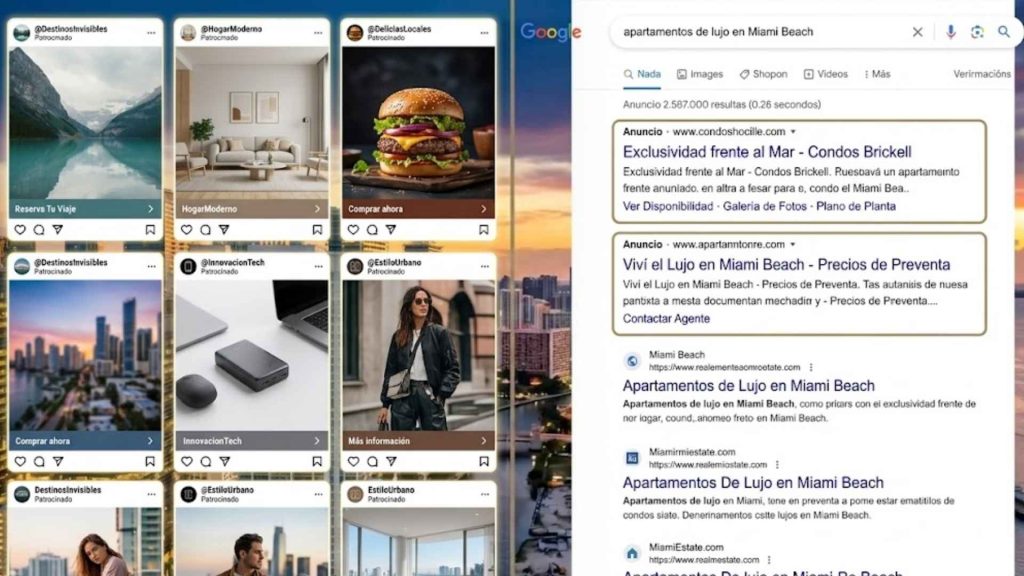
Digital advertising for real estate agencies
Paid advertising in real estate is the most complex of the three verticals due to the long decision cycle. The goal isn’t an immediate conversion the customer won’t buy an apartment after seeing one ad but rather to capture the prospect’s data and enter their decision process as early as possible.
Recommended campaign structure:
- Meta Lead Ads: the most effective format for real estate agencies on Meta because it allows capturing the prospect’s name, email, and phone without them leaving the platform. The pre-filled form with Facebook profile data reduces friction to a minimum and increases capture rates.
- Meta video ads with project or property tour: a 60 to 90-second video showcasing the project, the area, finishes, and associated lifestyle generates significantly higher engagement and contact intent rates than a static image.
- Google transactional Search Ads: campaigns for high-intent searches like “apartments for sale in [area],” “housing projects in [city],” or “invest in real estate in Miami.” These are searches with clear purchase intent and high conversion rates if the landing page is optimized.
- LinkedIn Ads for high-value buyers: especially effective for projects of USD 300,000 or more. LinkedIn allows segmentation by job title, industry, income level, and geography with a precision Meta doesn’t have for high-net-worth profiles. For Miami projects targeting Latin American buyers, LinkedIn in Spanish with country-of-origin targeting is a highly effective combination.
- Long-term retargeting: given the 6 to 18-month decision cycle, real estate retargeting should be configured with 30, 60, and 90-day windows, with creatives that evolve according to the funnel stage: from project introduction, to buyer testimonials, to urgency around last available units.
The 5 most common mistakes that waste budget
Based on the campaign audits we conduct at Digisap, these are the mistakes that cost hotels, restaurants, and real estate agencies the most money in their paid campaigns:
1. Campaign without an optimized landing page Sending paid traffic to the website’s home page instead of a specific landing page with a single conversion objective can reduce conversion rates by up to 70%. Every campaign needs its own dedicated destination page.
2. Targeting that’s too broad “People in Colombia aged 25 to 55 interested in travel” is an audience of millions. Efficient paid advertising requires precise targeting: purchase behaviors, specific interests, lookalike audiences of current customers, or exact search match terms. Broader doesn’t mean more useful reach.
3. Tracking pixel not correctly configured If the Meta pixel or Google conversion tag isn’t correctly installed and verified, the algorithm can’t optimize toward real conversions. It learns only if you give it correct data. Without data, it optimizes toward cheap clicks that don’t convert.
4. Static creatives running for months Meta’s algorithm penalizes ads that lose relevance due to audience fatigue. A creative that isn’t refreshed every 3 to 4 weeks drops in performance even if the budget stays the same. Continuous creative production isn’t a luxury: it’s part of the effective advertising budget.
5. Not running systematic A/B tests Without comparing variants of headline, image, copy, or call to action, it’s impossible to know what works best for your specific audience. The campaigns that convert best are those optimized with real data not assumptions.
For a look at how an effective digital advertising strategy is built in the specific context of restaurants with a focus on real results, the article on Google Ads for restaurants: boost your sales with effective campaigns details the tactics with the highest impact in the restaurant sector.
Case studies: campaigns that generated real results
Hotel in Orlando: Google Hotel Ads that outperformed OTAs
An independent hotel in Orlando had 85% of its bookings through OTAs with an average commission of 20%. By activating Google Hotel Ads connected to its booking engine with direct rates slightly lower than OTAs it achieved in four months that 34% of new bookings arrived through the direct channel, at a cost per booking of USD 18 versus an average commission of USD 24 for the same night on Booking. Campaign ROAS: 7.2x.
Restaurant in Bogotá: Meta Ads that filled tables on slow days
A restaurant in Bogotá’s La Macarena neighborhood with high weekend occupancy implemented short-radius Meta Ads campaigns (5 km) on Tuesdays and Wednesdays, featuring a “midweek menu” with a slight discount and high-impact visuals. With a budget of USD 300/week and targeting by food and dining interests and frequent dining-out behavior, it increased Tuesday-to-Thursday occupancy by 34% in six weeks. Cost per acquired diner: USD 4.20.
Real estate agency in Medellín: Meta Lead Ads for a luxury project
A luxury apartment project in Envigado launched a Meta Lead Ads campaign with a project tour video, high-socioeconomic targeting, investment and real estate interest segments, and geographic targeting in Medellín, Bogotá, and Miami. In the first month it generated 94 leads with a CPL of USD 32. The lead-to-visit conversion rate was 28%, and in 90 days 8 units were closed directly attributable to the campaign.
How Digisap manages paid advertising for its clients
At Digisap we manage paid advertising as part of a comprehensive growth strategy not as an isolated service. This means Meta Ads and Google Ads campaigns are connected with SEO, automation, CRM, and each client’s measurement system.
Our process includes:
- Existing campaign audit: if you already have active campaigns, we analyze them before recommending changes because often the problem isn’t the budget but the structure or segmentation.
- Campaign architecture design: we define the optimal structure of campaigns, ad groups, audiences, and budget by channel based on the business type and market.
- Creative production: we work with the creative team to produce images, videos, and copy that convert not just look good.
- Weekly optimization: we review performance every week, adjust bids, pause what doesn’t convert, and scale what works.
- Monthly reports with attribution: every month you see exactly how many bookings or leads each campaign generated, with the cost per conversion and real ROAS.
Is your paid advertising generating the return it should?
If you have active campaigns but can’t answer precisely how many bookings or leads they generated last month, there’s a measurement or strategy gap worth closing. Request your free Digisap diagnosis and within 48 hours we’ll audit your current campaigns and show you where the budget is being lost.
FAQs about Meta Ads and Google Ads for hospitality and real estate
What minimum budget do I need for campaigns to work?
It depends on the market and the objective. For a restaurant in Medellín, USD 300–500/month in Meta Ads is enough to see measurable results. For a hotel in Miami or a high-value real estate project, minimum viable budgets are higher (USD 1,500–3,000/month). What matters isn’t the absolute amount but the efficiency of the targeting and the quality of the creatives.
Is Meta Ads or Google Ads better for my business?
They’re not mutually exclusive, but they have different uses. Google Ads captures existing demand (users already searching for what you offer); Meta Ads creates new demand (reaches users who aren’t searching for you but fit your customer profile). The most effective strategy combines both platforms based on your customer’s decision cycle.
How long does it take to see a return on campaigns?
The first conversions can arrive within 48 to 72 hours of a well-configured campaign. However, real optimization where the algorithm learns from data and improves targeting takes between 4 and 8 weeks. ROAS in week 1 is always lower than ROAS in week 8.
Can I manage my own campaigns or do I need an agency?
Basic campaigns can be managed internally, but the results gap between a well-optimized specialist-managed campaign and one managed without experience can be 3x to 5x in ROAS. If the budget is significant for your business, specialized management pays for itself within the first 60 days.
What if campaigns don’t generate the expected return in the first months?
Digital advertising requires a learning and optimization period. If after the first 60 days ROAS is below target, the analysis should focus on three areas: audience segmentation, creative quality, and the post-click landing page experience. At Digisap we include unlimited adjustments during the first 90 days of any new campaign.
Paid advertising that works for the business, not against it
Meta Ads and Google Ads are the most powerful tools available today for hotels, restaurants, and real estate agencies that want to grow fast. But like any powerful tool, the difference between extraordinary results and wasted budget lies in who manages them and how.
At Digisap we build campaigns from the strategy up, with data-driven segmentation, converting creatives, and constant optimization that improves ROAS month by month. The goal is always the same: more direct bookings, more qualified leads, and a return that justifies and multiplies every dollar invested.
Schedule a personalized consultation and discover how we can transform the profitability of your paid advertising in the next 90 days.