The trap of depending on Booking and Expedia
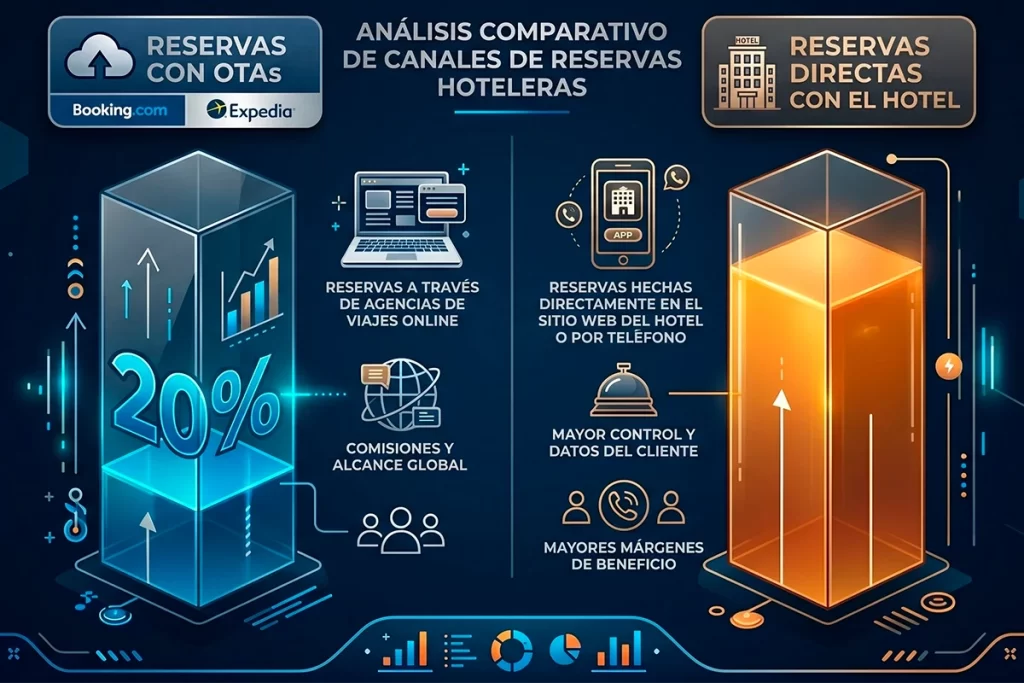
A boutique hotel in Medellín, Cartagena or Bogotá can have 85% occupancy and still have profitability problems. The reason is almost always the same: between 60% and 80% of those bookings come through OTAs that charge between 15% and 25% commission on every night sold.
The problem isn’t that OTAs exist. The problem is depending on them as the primary channel when there’s an alternative that charges no commission, builds brand and generates your own guest data: the direct channel well-positioned on Google.
Hotel SEO isn’t magic. It’s systematic work that takes between 3 and 6 months to show solid results. But hotels that do it well stop competing on price on third-party platforms and start receiving guests who searched for them directly, chose their website and booked without intermediaries.
Why SEO works differently for boutique hotels
Boutique hotels have an advantage that large chains can’t easily replicate: specificity. A traveler searching for “boutique hotel with a view in El Poblado Medellín” or “design hotel in Getsemaní Cartagena” has already made a style decision. They’re not comparing prices on Booking — they’re looking for a specific experience.
That search intent is exactly where well-executed SEO can win. Large chains optimize for generic, high-volume terms. A boutique hotel can dominate more specific searches with less competition and higher conversion rates.
The concrete benefits of building that positioning:
- Qualified traffic with no cost per click. Unlike Google Ads, organic traffic has no variable cost. Every visit that comes through SEO is margin that doesn’t get paid out.
- Visibility in high-intent searches. Someone searching “pet-friendly boutique hotel Medellín” has already filtered by accommodation type, city and feature. The conversion rate of that traffic is significantly higher than generic traffic.
- Gradual reduction of OTA dependence. As the direct channel grows, the proportion of bookings with commission drops. That recovered margin can be reinvested in marketing or in improving the guest experience.
- Your own client data. OTAs don’t share guest information. The direct channel does. That allows you to build databases for email marketing, loyalty programs and remarketing campaigns.
How hotel SEO works in practice
Keyword research with booking intent
The first step isn’t writing content. It’s understanding how the ideal guest searches. For a boutique hotel in Colombia, that means identifying terms like:
- “boutique hotel [city] direct booking”
- “best boutique hotels in [neighborhood or area]”
- “design hotel in [city] with [specific feature]”
- “where to stay in [city] without paying Booking”
Those searches have less volume than “hotels in Medellín” but convert much better because the user is already in decision mode.
Technical website optimization
A slow website, without a functional mobile version or with indexing problems, won’t rank well no matter how much content it has. The basic technical aspects a boutique hotel needs to resolve before any content strategy:
- Loading speed under 3 seconds on mobile.
- Clean, descriptive URL structure.
- Booking engine correctly integrated and crawlable by Google.
- Hotel schema markup correctly implemented.
- Active SSL certificate with no security errors.
Content that ranks and converts
SEO content for hotels isn’t just publishing blog articles. It’s optimizing every page on the site: the homepage, room pages, services, location and specific landing pages by season or traveler type.
A boutique hotel in Cartagena that creates a specific page for “honeymoon in Cartagena” or “boutique hotel for business travelers in the Historic District” captures highly specific traffic that a generic page would never reach. Hotels that best understand this principle are the ones that make SEO the primary engine of their direct bookings without depending on permanent paid media.
Google Business Profile and local SEO
For boutique hotels, a well-optimized Google Business Profile can be the most important local traffic source. A profile with updated photos, review responses, correct hours and well-assigned categories appears on the Google map when someone searches for accommodation in the area. That traffic is free, local and high-intent.
Technology and measuring the SEO channel
Without measurement there’s no optimization. Connecting Google Analytics 4 with Search Console lets you see exactly which terms drive visits to the site, which pages convert best and where users drop off before booking. That data guides content and technical optimization decisions month after month.
Before and after: a boutique hotel that bet on the direct channel
An 18-room boutique hotel in the Provenza neighborhood of Medellín came to Digisap with 74% of its occupancy dependent on OTAs and an operating margin squeezed by commissions averaging over 20%.
The work began with a technical site audit, speed and structure optimization, keyword research specific to their segment and area, and creation of landing pages for high-value searches like “boutique hotel in Provenza Medellín” and “design accommodation El Poblado direct booking.”
At 4 months, organic traffic had grown 112%. At 6 months, the direct channel represented 31% of total bookings, up from 26% at the start. OTA commissions dropped proportionally and the hotel recovered enough margin to invest in improving the guest experience and a Google Hotel Ads campaign that further accelerated the direct channel.
SEO as competitive advantage over large chains
Hotel chains have marketing budgets that a boutique hotel can’t match in paid media. But in SEO, the fight isn’t about budget — it’s about relevance and specificity.
A boutique hotel that dominates specific searches for its area, traveler type and value proposition competes on terrain where size matters less than precision. That’s exactly what makes SEO a strategic channel for independent hotels that want to grow without depending on platforms that take a cut of every booking.
How Digisap approaches hotel SEO
The process doesn’t start with content. It starts with data.
- Technical and content audit: identification of errors blocking current positioning.
- Keyword research: mapping of terms with direct booking intent.
- On-page optimization: titles, meta descriptions, heading structure, speed and structured data.
- Content strategy: landing pages, blog articles and updates to existing pages.
- Link building: building authority through mentions and links from relevant tourism sector sites.
- Monthly measurement: positioning reports, organic traffic and conversions attributed to the SEO channel.
The goal isn’t to be on Google. It’s that when your ideal guest searches for exactly what your hotel offers, your site appears first and has everything needed for them to book without leaving it.
Ready to reduce commissions and build your direct channel?
The first step is knowing the current state of your site: speed, current positioning, technical errors and keyword opportunities. At Digisap we do that diagnosis at no cost for boutique hotels that want to start building their direct channel with SEO.
Find out how we work and request your personalized consultation
What we get asked most
How long does SEO take to generate direct bookings for a boutique hotel?
The first positioning movements are visible between month 2 and month 3. Bookings directly attributable to the SEO channel typically appear between month 4 and month 6, depending on the initial technical state of the site and competition in the local market.
Does SEO completely replace OTAs?
Not necessarily, and it doesn’t have to. The goal is to reduce dependence, not eliminate the channel. A hotel that goes from 75% to 40% of bookings through OTAs is already recovering significant margin. OTAs also have value as a discovery channel for new guests.
What’s more important for a boutique hotel: SEO or Google Ads?
They depend on objectives and timing. Google Ads generates results from the first week but requires constant investment. SEO takes longer but generates traffic with no cost per click once positioned. The combination of both is what builds the direct channel fastest.
Can a small hotel compete in SEO with large chains?
Yes, precisely because chains can’t be specific for every area, neighborhood or traveler type. A boutique hotel that optimizes for “hotel with private terrace in Getsemaní” competes in a space where large chains have no page or relevant content.
What does a hotel website need for SEO to work?
Fast loading speed, responsive design, integrated booking engine, specific pages by room type and experience, optimized Google Business Profile and a correct Analytics implementation to measure conversions. Without those base elements, SEO can’t work well.
Less commission, more margin, more control
Every booking that comes through the direct channel is a booking that pays no commission, generates your own guest data and builds a direct relationship with the client. Hotel SEO is the channel that makes that possible in a sustainable way. It’s not the fastest channel, but it generates the best medium-term return. Boutique hotels in Colombia that are gaining independence from OTAs are the ones that started working on their organic positioning 6 or 12 months ago, and today see that work translate into direct bookings that don’t depend on intermediaries or monthly ad spend.
Download our free SEO guide for hotels