E-commerce in Colombia is no longer just for big brands
In 2024, e-commerce in Colombia moved over 50 trillion pesos. In 2026, that number keeps growing and the online stores gaining market share aren’t necessarily the biggest — they’re the most strategic.
An e-commerce selling kitchen accessories in Bogotá, sportswear from Medellín or artisan products for export can compete with established brands with the right digital structure. The problem is that most online stores in Colombia still operate with five-year-old strategies: Meta ads, some basic SEO and hope.
In 2026, that’s not enough. These are the seven strategies generating real results.
7 strategies to increase sales in your e-commerce in 2026
Strategy 1: Technical and product SEO as the foundation of organic traffic
Paid traffic costs more every day. Organic traffic has no variable cost once positioned. An e-commerce that optimizes its product pages with purchase-intent keywords, fast loading speed, correct structured data and a clean category architecture builds an asset that generates sales without depending on the monthly paid media budget.
Technical SEO for e-commerce isn’t optional in 2026 — it’s the foundation on which everything else works better.
Strategy 2: Well-structured Google Shopping campaigns
Google Shopping places the product with photo, price and name directly in search results. A user searching “women’s running shoes size 38 Bogotá” and seeing the product with visible price before entering the site has much higher purchase intent than one arriving from a generic ad.
Poorly structured Shopping campaigns waste budget on low-margin or low-conversion products. Well-structured ones concentrate investment on the products that sell most and with the highest margin.
Strategy 3: Abandoned cart recovery
On average, 70% of users who add a product to the cart on an e-commerce don’t complete the purchase. That represents an enormous amount of revenue that walks away without intervention.
A well-designed recovery sequence — email at 30 minutes, WhatsApp at 2 hours, email with offer the next day — can recover between 10% and 25% of those abandoned carts. That recovery doesn’t require more traffic: it works with users who already decided to buy but didn’t finish the process.
Strategy 4: Email marketing as a repurchase channel
Acquiring a new client costs between 5 and 7 times more than selling again to an existing one. Well-executed email marketing is the most profitable channel for activating repurchase in an existing client base.
A post-sale sequence that includes order confirmation, shipping tracking, review request and complementary product offer can increase average ticket and purchase frequency without additional acquisition investment.
Strategy 5: Social ads with behavioral and intent targeting
The Meta ads that convert best in e-commerce in 2026 aren’t the ones that reach the most people — they’re the ones that reach the right people. Targeting by purchase behavior, prior website interaction (remarketing) and lookalike audiences based on the best current clients generates significantly higher conversion rates than broad audiences.
Strategy 6: Mobile experience optimization
In Colombia, over 70% of online purchases are initiated from a mobile device. An e-commerce with a slow mobile version, images that don’t load properly or a complicated checkout process on a small screen is losing the majority of its potential buyers before they reach the payment stage.
Mobile speed, one-step checkout and payment through digital wallets like Nequi or Bancolombia are no longer differentiators — they’re minimum requirements.
Strategy 7: Personalization with first-party data
The e-commerce stores growing fastest in Colombia in 2026 are the ones using behavioral data from their own users to personalize the experience: product recommendations based on previous purchases, targeted offers based on browsing history and communications adapted to the customer’s lifecycle stage.
That doesn’t require Fortune 500 technology. It requires having Google Analytics 4 correctly configured, a basic CRM and an email marketing strategy that uses that data.
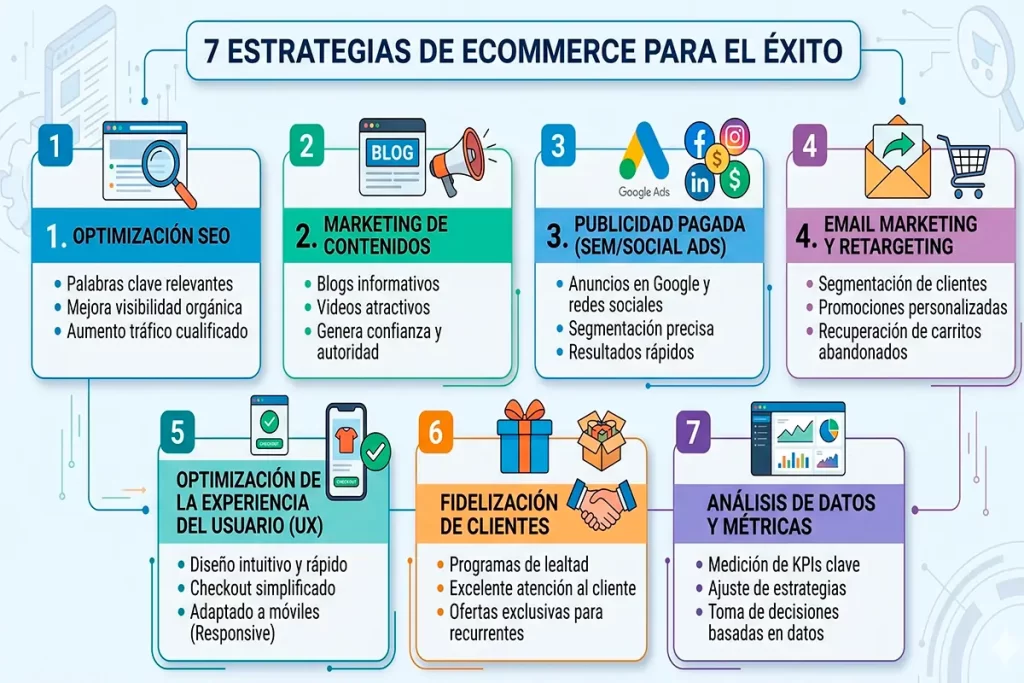
What an e-commerce that applies these strategies looks like
Home accessories store in Bogotá Before: traffic almost 100% from paid media, rising acquisition cost, squeezed margins. After: with technical and product SEO, in 6 months 35% of traffic arrived through organic channel. Acquisition cost dropped 28% and margin improved proportionally.
Fashion e-commerce in Medellín Before: abandoned carts without follow-up, no recovery sequence. After: with an email and WhatsApp recovery sequence, 18% of abandoned carts converted to purchase. That represented a 22% increase in monthly revenue without increasing the acquisition budget.
Why specialization matters in e-commerce
An agency that manages e-commerce for mass consumer products doesn’t have the same knowledge as one that works with businesses where the customer experience, average ticket and repurchase cycle have very different dynamics. The e-commerce stores that grow most are the ones working with teams that understand both the technical side and the business logic behind each purchase decision. E-commerce positioning strategies in Colombia show how that specialized approach translates into concrete sales results.
How Digisap works with e-commerce
The process starts with a technical site audit: speed, on-page SEO, category structure, Analytics configuration and active campaigns. From there, improvements are prioritized by sales impact and an implementation plan is built in phases. Every month the metrics that matter are reported: organic traffic, ROAS by channel, conversion rate, average ticket and acquisition cost.
Is your e-commerce growing at the rate it should?
A free audit can reveal exactly where sales are being lost and what has the most potential for improvement with the least investment.
Find out how we work and request your personalized consultation
What we get asked most
How much should an e-commerce in Colombia invest in digital marketing?
As an initial reference, between 10% and 15% of monthly revenue allocated to digital marketing is a reasonable range for e-commerce in growth stage. What matters is that every channel has return traceability.
SEO or paid ads for e-commerce?
Both, but with different roles. Paid media generates immediate results and is ideal for launches, seasons and new products. SEO builds sustainable long-term traffic. An e-commerce that only runs paid ads always depends on the monthly budget. One that combines both builds an asset.
How do I know if my e-commerce is losing sales due to technical problems?
Google Search Console and PageSpeed Insights show indexing and speed errors. Google Analytics 4 shows at which point in the purchase process users are lost. With those two tools you can identify most of the technical problems affecting sales.
Is it worth investing in abandoned cart recovery?
Yes. It’s one of the strategies with the best ROI in e-commerce because it works with users who already showed purchase intent. The investment in setting up the recovery sequence pays for itself in the first few weeks.
What e-commerce platform do you recommend for Colombia?
It depends on volume and needs. Shopify is the most robust option for most cases. WooCommerce works well for businesses already on WordPress. What matters most isn’t the platform but that it’s correctly configured technically for SEO and conversion.
More traffic isn’t always the answer
Many e-commerce stores in Colombia look to grow by investing more in paid ads when the real problem is the conversion rate, abandoned carts or the absence of a repurchase strategy. Before increasing the acquisition budget, it makes more sense to optimize what already exists. An e-commerce that converts at 3% instead of 1% triples its sales with the same traffic. That’s the kind of growth built with strategy, not budget. E-commerce in Miami and international markets follows exactly those principles to compete in much more demanding markets.
Schedule a free audit of your e-commerce