What you don’t measure, you can’t fix
Most restaurants in Colombia have a digital presence. An Instagram page, a Google Maps profile, maybe some Meta Ads. But having a presence isn’t the same as having a strategy. And the difference between the two is measured in empty tables.
The mistakes that cost restaurants the most clients aren’t obvious ones. They’re decisions that seem reasonable — posting nice content, having lots of followers, investing in paid ads — but that without the right structure don’t generate real bookings or sales. These are the five that come up most often.
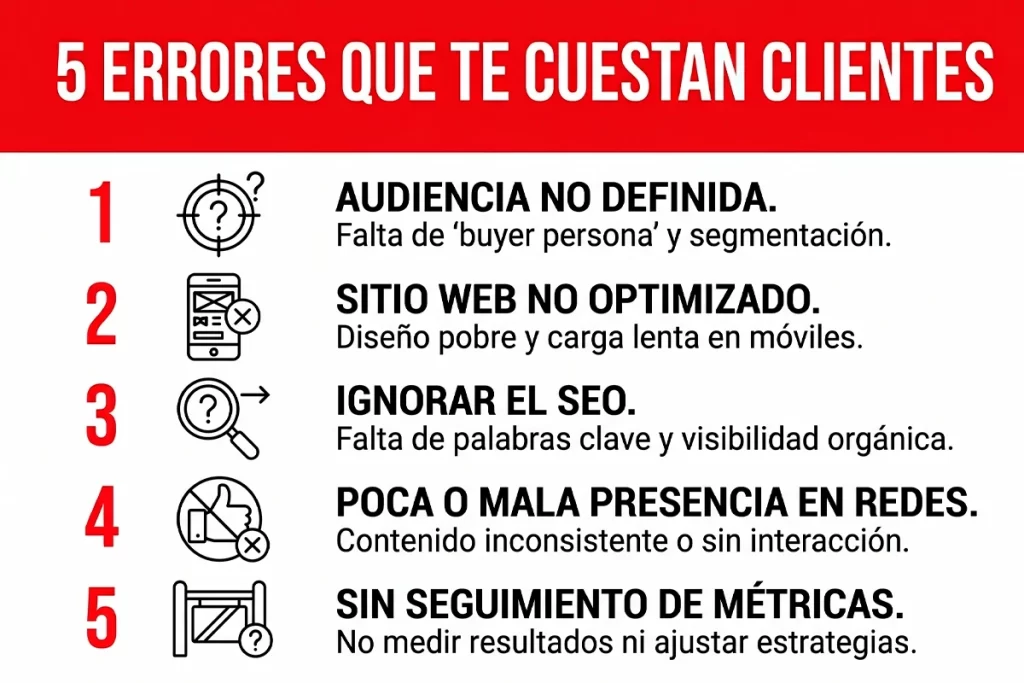
The 5 mistakes that do the most damage
Mistake 1: Betting everything on Instagram and neglecting Google
Instagram is the channel where restaurants invest the most time and money. And it makes sense: it’s visual, generates engagement and builds community. The problem is that Instagram doesn’t capture active demand. When someone is hungry and searches “Japanese restaurant in Laureles” or “best brunch in Bogotá,” that search happens on Google, not on Instagram.
A restaurant with 50,000 Instagram followers that doesn’t appear in the top Google Maps results is losing clients who already decided to go out to eat and are looking for options right now. That immediate purchase intent is worth more than any like.
Mistake 2: Not keeping the Google Business Profile updated
The Google Business Profile is the most underrated digital asset a restaurant has. It’s the first thing that appears when someone searches the restaurant’s name or looks for options nearby. A profile with outdated photos, wrong hours, no review responses or no menu uploaded communicates carelessness before the client even sets foot in the place.
Worse: a profile with unmanaged negative reviews can destroy a restaurant’s online reputation in weeks. A one-star review with no response says more about the restaurant than ten five-star reviews.
Mistake 3: Investing in paid ads without measuring conversions
Many restaurants invest in Meta Ads or Google Ads and evaluate results by the number of likes or the reach of the ad. Those metrics don’t pay the rent. What matters is how many bookings, calls or visits each peso invested in paid media generated.
Without Meta pixel installed, without conversion tracking in Google Ads and without Google Analytics 4 correctly configured, it’s impossible to know if the paid ads are working or if the budget is evaporating without return. Restaurants that manage their online reputation and campaigns with real data have an enormous advantage over those that operate on intuition.
Mistake 4: Posting content without a conversion strategy
Posting nice photos of dishes isn’t a marketing strategy. It’s digital decoration. Content that generates bookings has a clear objective: to take the user from the post to a concrete action — booking a table, calling the restaurant or clicking the link in the bio.
An Instagram post showing the weekend menu with no clear call to action, no direct link to booking and no visible hours is wasting whatever reach it got. Content has to work for the business, not just for the feed.
Mistake 5: Not having an online booking system
Depending exclusively on phone calls to manage reservations in 2026 is both an operational and marketing problem. Operational because it limits booking capacity to the hours when someone can answer the phone. A marketing problem because it doesn’t generate client data that can be used for remarketing, loyalty or email campaigns.
An online booking system — integrated with the website and with automatic confirmation by WhatsApp or email — captures the client at the moment of highest intent and eliminates the friction that makes many give up before confirming.
What a restaurant with the right strategy looks like
Real investment and return
A restaurant in Bogotá with well-targeted Meta Ads campaigns, an optimized Google Business Profile and an online booking system can see returns of between 5X and 10X on paid media investment in high season. That’s not an ideal number — it’s what happens when the channels are properly connected and every peso has traceability.
Channels that generate bookings, not just visibility
- Local SEO: appearing in the top Google Maps results for immediate-intent searches.
- Google Ads: capturing active searches like “romantic restaurant Medellín booking” with ads that go directly to the booking page.
- Meta Ads with remarketing: re-engaging users who visited the website or interacted with the profile but didn’t book.
- Automated WhatsApp Business: confirming reservations, sending reminders and managing changes without manual intervention.
Technology and measurement
The difference between a restaurant that grows and one that stagnates is often not the food or the service — it’s the information. Knowing which channel generated each booking, which post converted best and at what point clients are lost allows decisions that improve the business week after week.
How Digisap works with restaurants
The work doesn’t start with content or paid ads. It starts with an audit of what already exists: Google Business Profile, social media presence, Analytics configuration, booking system and active campaigns. That audit defines exactly what’s failing and what has the most potential for improvement with the least investment.
From there, a strategy is built with clear objectives: weekly bookings, cost per booking, organic traffic and online reputation. Those numbers are reported with full transparency every month.
Want us to review your restaurant’s digital marketing for free?
Most restaurants make more than one of these mistakes simultaneously. Identifying them is the first step to fixing them. At Digisap we do that review at no cost.
Find out how we work and request your personalized consultation
What we get asked most
How much should a restaurant invest in digital marketing?
Depending on size and objectives, a mid-sized restaurant in Colombia with between 50 and 150 covers should consider between COP $2,000,000 and $5,000,000 monthly in paid media, plus organic channel management. What matters isn’t the amount but that every peso has follow-through.
Is Instagram still relevant for restaurants?
Yes, but as a brand-building and community channel, not as the primary bookings channel. The combination that works is Instagram for visibility and Google for capturing active demand.
How do I know if my Meta or Google campaigns are working?
If you can’t answer how many bookings each campaign generated last week, you’re probably not measuring well. A correct tracking system tells you exactly which ad, which audience and which budget generated each booking.
Is it worth responding to every Google review?
Yes, especially negative ones. A well-written response to a one-star review can reverse the perception of potential clients who read it. Ignoring negative reviews is one of the most costly mistakes in terms of online reputation.
What booking system do you recommend for restaurants in Colombia?
It depends on volume and the integration needed. What matters most is that it’s connected to the website, that it sends automatic confirmations and that it generates client data that can be used for subsequent marketing.
The problem isn’t the food. It’s the visibility.
A restaurant with a solid gastronomic proposition but accumulated digital mistakes is losing clients every day to competitors that aren’t necessarily better — just more visible. Fixing those mistakes doesn’t require enormous budgets: it requires structure, measurement and consistency. Restaurants that understand local SEO as part of their client acquisition strategy stop depending on word of mouth and build a steady flow of new clients.
Want us to review your restaurant’s digital marketing for free? Write to us