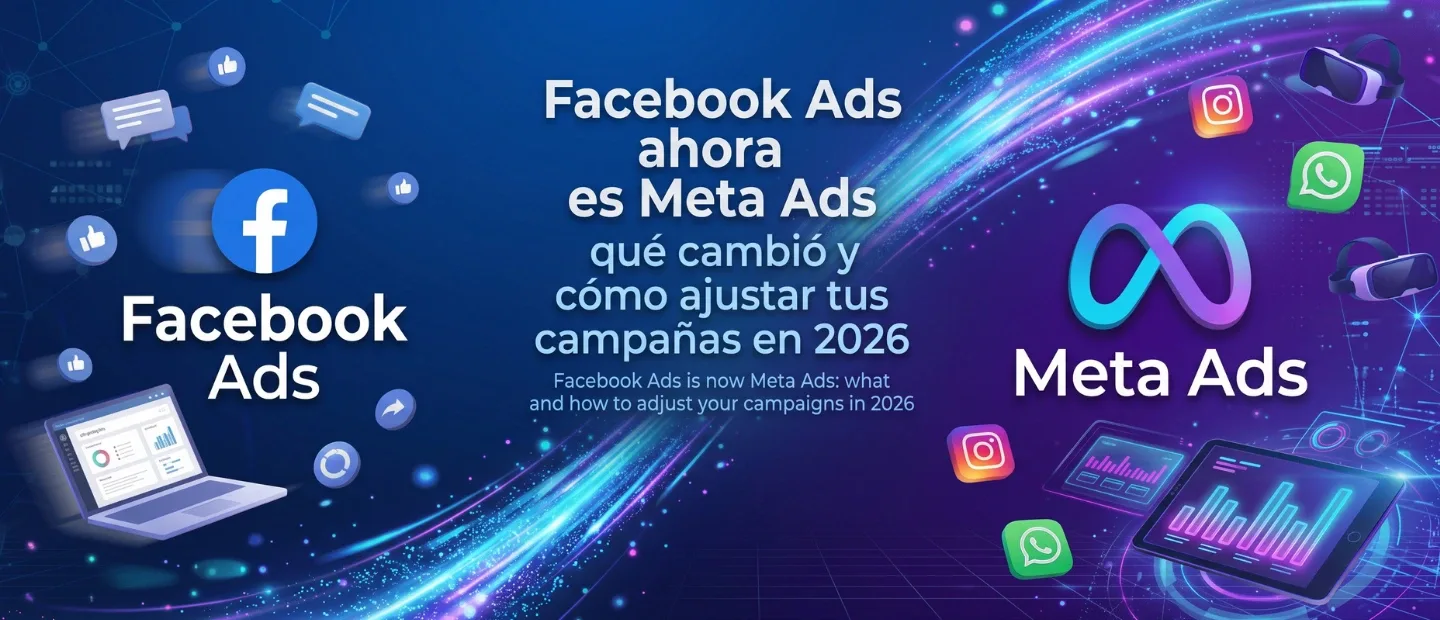
Facebook Ads became Meta Ads as part of the rebrand that began in October 2021, when Facebook Inc. became Meta Platforms. Over time, that name change turned into a deeper shift: in 2026 the platform runs on more automation, more AI and less manual control than ever before.
This guide covers what changed, what stayed the same and what to adjust in your campaigns so your Meta ad spend keeps driving revenue.
Why Facebook Ads is now called Meta Ads
Once Facebook became Meta in 2021, the company set out to build an identity bigger than a single social network. With Instagram, WhatsApp, Messenger and Facebook under one roof, the “Facebook Ads” name no longer described everything the platform offered advertisers.
Today, Meta Ads covers the company’s full advertising ecosystem:
- Messenger
- Audience Network
It follows the same path Google took when AdWords became Google Ads: one system for several channels. If you advertise on both platforms, this guide on how to split your budget between Meta and Google Ads can help.
What changed in how you advertise
The new name was only the first step. The changes that matter most for campaigns came later, and they picked up speed between 2025 and 2026.
Advantage+ as the default way to buy media
Advantage+ is Meta’s suite of AI tools that automates audiences, placements, budget and creative. What began as an option for ecommerce brands became the default way to build campaigns. In October 2025, Meta stopped allowing new legacy Advantage+ shopping and app campaigns through its API and folded them into a single Advantage+ sales campaign format.
Fewer manual controls
Some settings advertisers used to switch off, such as automatic expansion of detailed targeting for certain objectives, are now on by default. Manual campaigns still exist and still have clear jobs: retargeting, tightly defined audiences, new accounts with little history and controlled creative tests.
Creative now does the targeting
Meta’s ad delivery system now leans on creative to find the right audience. That is why accounts with a few consolidated campaigns, fed with strong assets and enough conversions, tend to outperform structures split into dozens of fragmented ad sets. According to industry reports, the number of advertisers using Meta’s AI creative tools doubled to about 8 million in early 2026.
A more centralized management console
Ads Manager is still the heart of day-to-day work, while Meta Business Suite brought together publishing, messaging and insights for Facebook and Instagram that used to live in separate tools.
What stayed the same
- Campaigns created before the rebrand kept running without interruption.
- The logic of objectives, budgets and ad formats is still there.
- The Meta Pixel (formerly the Facebook Pixel) remains the foundation of tracking, now paired with the Conversions API.
- You still need a clear strategy: automation performs best when the business feeds it good signals.
How this affects your digital marketing strategy
Cross-channel campaigns inside Meta
Meta Ads makes it easy to run campaigns across Facebook, Instagram and WhatsApp. For a hotel, a restaurant or a real estate brand, that means showing an ad on Instagram and closing the conversation on WhatsApp, all within the same measurement setup.
Automation with judgment
Advantage+ can lift returns with less hands-on management, but it amplifies whatever it is given. If conversion events are misconfigured or the creative is weak, the algorithm scales those mistakes faster than a manual campaign would. Deciding when to automate and when to take control is still a human call. Review results every week, and give each structural change enough time to exit the learning phase before judging it.
Measurement built on first-party data
Since the iOS 14.5 privacy changes, Meta relies more and more on modeled conversions. To avoid depending only on platform reporting, pair the Meta Pixel with your own campaign analytics, connected to GA4, the Conversions API and real business sales. That way you can compare what Meta reports with the revenue that actually came in.
What advertisers should do in 2026
- Update your language: use “Meta Ads” in reports, decks and training.
- Review your account structure: consolidate fragmented campaigns so the algorithm gets more conversion volume per campaign.
- Protect your signals: check that the Pixel and the Conversions API send the right events, with no duplicates.
- Invest in creative: produce variations in format, message and hook, since creative is now your main targeting lever.
- Keep manual campaigns where they add value: retargeting, niche audiences and controlled tests.
- Bring in specialists: if your team lacks the time to test Advantage+ and rework your account structure, our Meta Ads and Google Ads campaign management blends automation with manual control and incrementality-based decisions.
Meta Ads FAQ
Are Facebook Ads and Meta Ads the same thing?
Yes. Meta Ads is the current name of the advertising platform formerly known as Facebook Ads. It covers ads on Facebook, Instagram, Messenger, WhatsApp and Audience Network.
Do my old Facebook Ads campaigns still work?
Campaigns created before the rebrand stayed active. What did change in 2025 was how new Advantage+ shopping and app campaigns are created: Meta merged them into the Advantage+ sales campaign format.
Should I use Advantage+ or manual campaigns?
It depends on your conversion volume and objective. Advantage+ tends to perform best with enough weekly conversions and strong creative. Manual campaigns remain useful for retargeting, specific audiences and controlled tests.
Do I still need the Meta Pixel?
Yes. The Pixel is still the foundation of tracking, and it works best alongside the Conversions API, which sends events from your server and reduces data loss from privacy changes.
From Facebook Ads to Meta Ads, a platform that rewards strategy
The move from Facebook Ads to Meta Ads started as a rebrand and ended up redefining how media is bought on Facebook and Instagram. The platform now automates more decisions, and the advertisers who perform best are the ones who give it strong signals, strong creative and reliable measurement.
If you want a second look at how your Meta campaigns are set up and what to change for 2026, let’s talk.