
Plenty of companies spend years building traffic, only to find that it barely turns into sales. At Milenio PC, a B2B IT services company in Colombia, an audit showed that about 18% of users clicked “Contact us” and never submitted the form. Traffic was arriving; the leak was in lead capture.
CRO (conversion rate optimization) is the work of closing those leaks. This guide covers what conversion rate measures, how to find where visitors drop off and how to test changes without guessing. If you already track several metrics and aren’t sure which one to prioritize, pair this guide with our article on ROAS, CPA and conversion rate: which KPIs to prioritize.
What CRO is and what conversion rate measures
Conversion rate is the percentage of visits that complete the action you care about. Divide conversions by sessions (or users) and multiply by 100. If 2,000 sessions produce 40 quote requests, your conversion rate is 2%.
Everything depends on defining a conversion correctly. For a hotel it is a booking in the engine; for a B2B company, a submitted form or a WhatsApp click; for an online store, a purchase. Track two levels:
- Macro conversions: the action that generates revenue or a real sales opportunity.
- Micro conversions: earlier steps that signal buying intent, such as viewing the pricing page, downloading a catalog or starting a form.
CRO works on both. Micro conversions show where people stall; macro conversions tell you whether a change actually moves the business.
Step 1: get tracking right before changing anything
Without reliable data, every improvement is a guess. Before touching the design, confirm your analytics captures what matters:
- Key events in GA4: mark only actions with commercial value as key events in GA4. A site with 15 key events ends up with none that guide decisions.
- WhatsApp and phone clicks with source: for many businesses serving Latin American customers, a large share of conversions happens on WhatsApp. If you don’t record which page and campaign drove each click, that conversion is invisible.
- CRM connection: a submitted form is not a sale. Matching web leads with what happens next in your CRM shows which sources bring customers and which only bring contacts.
- Consent and modeled data: with cookie banners in place, part of your conversions are modeled. Keep that in mind when comparing periods.
Setting up this layer is where our data and analytics work starts: without it, there is no way to know whether a change helped or hurt.
Step 2: find where the funnel breaks
Once tracking is in place, locate the leaks. Three sources work best together:
- Funnel explorations in GA4: map the real path (landing page, service page, form, submission) and see where the biggest drop happens.
- Heatmaps and session recordings: tools like Microsoft Clarity, which is free, show where users click, how far they scroll and which form field they abandon.
- Conversations with your sales team: the questions customers keep asking by phone or WhatsApp reveal what your website is missing.
At Milenio PC, comparing “Contact us” clicks with submitted forms surfaced the 18% of users who showed intent and dropped off at the final step. That number turned a vague feeling (“the website doesn’t sell”) into a specific problem with a fix.
Step 3: prioritize hypotheses
An audit usually produces 20 or 30 improvement ideas. Testing them all at once makes it impossible to tell what worked. Rank them with a simple framework like ICE:
- Impact: how much it could move conversion if it works.
- Confidence: how well the data from step 2 supports it.
- Ease: how much design and development effort it requires.
Score each idea from 1 to 10 on all three and start with the highest averages. Write each one as a testable hypothesis: “if we replace the 9-field form with a WhatsApp button that tracks source, contacts from service pages will increase.”
Step 4: test changes properly
An A/B test shows two versions of a page to different groups of users and compares their conversion. For a result you can trust:
- Change one variable per test: if you change the headline, image and button at once, you won’t know what made the difference.
- Run full cycles: let the test run for at least two full weeks so it covers weekdays and weekends.
- Don’t stop early: the first few days often show differences that vanish with more data. Set your sample size in advance.
- Use current tools: Google Optimize shut down in 2023. Teams now use platforms such as VWO, Optimizely, AB Tasty or Convert.
With low traffic, an A/B test can take months to reach a clear result. In that case, ship the change, compare equivalent periods and log anything else that changed at the same time, such as campaigns or seasonality.
Funnel improvements that often move conversion
Every site is different, but some fixes come up in audit after audit:
- Less friction at the point of contact: shorter forms, a visible WhatsApp button and tap-to-call on mobile.
- One landing page per intent: a page for each service, product or city, with messaging and a call to action matched to that search.
- Social proof near the button: testimonials, client logos or reviews right where the user decides.
- Mobile speed: every extra second of load time on an average mobile connection means more people leave before seeing your offer.
- Answers to common doubts: price ranges, delivery times and FAQs make it easier to reach out.
Once the funnel is in order, the next step is connecting those improvements with technology and automation. We cover that in our step-by-step guide to improving direct sales with technology, automation and CRO.
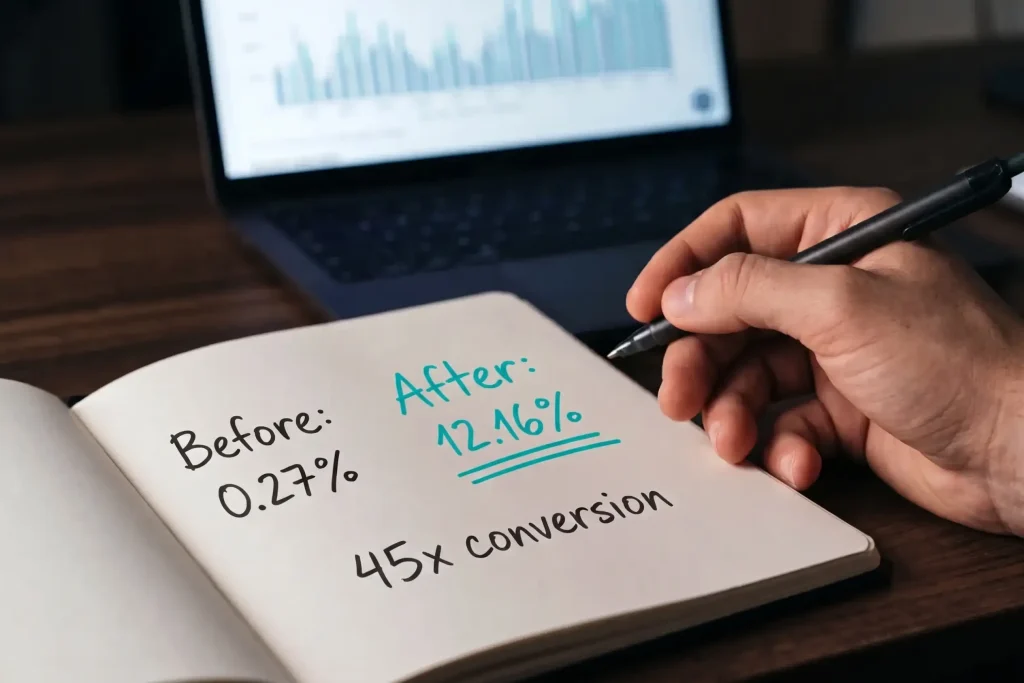
Milenio PC case: key event conversion went from 0.27% to 12.16%
Milenio PC has held top SEO and SEM positions in its category for more than 16 years. The challenge was turning that visibility into sales opportunities: key event conversion sat at 0.27%.
The work focused on three fronts:
- Less friction at the point of contact: WhatsApp buttons with source tracking and mandatory CRM integration.
- 15 standalone landing pages: each one optimized for a service, a product or a Colombian city.
- Video content with testimonials: social proof validated with a 9.4 out of 10 satisfaction score.
Key event conversion reached 12.16%, 45 times the starting point. See the full Milenio PC case study.
The CRM integration made the difference because it showed which contacts became sales. Aligning marketing, sales and revenue data in a single process is the focus of our revenue operations service.
Common conversion optimization mistakes
- Copying changes from another site: what worked for an online store may not suit a B2B service with a long sales cycle.
- Optimizing the wrong micro conversion: more PDF downloads mean little if those people never buy.
- Ignoring mobile: most traffic comes from phones, yet many teams review their site only on desktop.
- Tracking forms only: if customers message you on WhatsApp or call, part of your conversion never reaches the report.
- Changing everything in a redesign: a full redesign without prior testing can lower conversion with no way to tell why.
Frequently asked questions
What is a good website conversion rate?
It depends on your industry, the type of conversion and the traffic source. An e-commerce purchase and a B2B form are not comparable. The most useful benchmark is your own history: track your current rate by source and by page, and improve it quarter over quarter.
How long should an A/B test run?
At least two full weeks, and always until you reach the sample size you set before starting. Stopping when one version seems to win in the first few days usually leads to the wrong conclusion.
Can you do CRO with low traffic?
Yes. With low traffic A/B tests take longer, so prioritize high-impact changes, lean on session recordings and compare equivalent periods before and after each change.
Should I invest in traffic or conversion first?
If your site already gets quality visits and converts poorly, improving conversion usually pays off faster. Every point of improvement multiplies the return on all the traffic you already pay for or earn through SEO.
Request your conversion audit
At Digisap we review your tracking, pinpoint the leaks in your funnel and deliver a prioritized plan of fixes and tests. Request your conversion audit.