
Ask ChatGPT for a boutique hotel in Miami Beach, a realtor in Orlando who works with international buyers or a marketing agency in Bogotá, and it answers with three to five names. Those names capture a buyer who has already decided to spend and is only choosing who gets the business. Making that shortlist comes down to specific signals your team can start working on today.
This guide turns those signals into steps. For the conceptual framework, the difference between GEO and AEO and the method we use at Digisap, start with our guide GEO and AEO: what it is and how to get AI to recommend you. Here we focus on what to do, in what order and how to measure it.
How ChatGPT, Gemini and Perplexity decide who to recommend
All three assistants blend what the model learned in training with live web search. ChatGPT searches the web through its own crawler, OAI-SearchBot, and third-party search providers. Gemini draws on Google’s index and Knowledge Graph. Perplexity crawls with PerplexityBot and shows its sources next to every answer.
The practical takeaway is simple. If your business is poorly indexed in Google and Bing, or described differently on every site, the assistant has little reliable material to cite. When in doubt, it recommends whoever has the most consistent sources.
Step 1: let AI crawlers read your site
Plenty of sites block AI bots without realizing it, through security plugins, CDN rules or a robots.txt inherited from a previous agency. Check three things:
- robots.txt: make sure OAI-SearchBot, PerplexityBot, Googlebot and Bingbot can reach the pages you want cited. Review the Google-Extended directive too, which governs some uses of your content in Gemini products. Google’s AI Overviews rely on regular Googlebot crawling.
- Content in the HTML: if your rates, services or listings only load through JavaScript, many crawlers miss them. Key copy should be in the HTML the server delivers.
- Bing indexing: verify your site in Bing Webmaster Tools. It takes minutes and many businesses have never done it.
Step 2: build a consistent entity
To an AI assistant, your business is an entity: a name tied to a category, a location and a set of attributes. The more those details match across sources, the more confident the model is about naming you.
- Use the same name, address, phone number and category on your website, Google Business Profile, LinkedIn, industry directories and platforms like Tripadvisor, Zillow or Yelp.
- Write a one-line description of what you do, who you serve and where. Repeat that same idea everywhere.
- Add Organization or LocalBusiness structured data with a sameAs property pointing to your official profiles.
- Keep an About page with verifiable facts: founding year, offices, team and published clients.
Step 3: earn mentions in the sources AI already trusts
Assistants give a lot of weight to what independent sources say about your business. That makes off-site work just as important as what happens on your website.
Start with a prompt audit. Type into ChatGPT, Gemini and Perplexity the 15 to 20 questions your ideal customer would ask, such as “best boutique hotel in South Beach” or “realtor in Orlando for buyers from Latin America”. Note which businesses come up and, above all, which sources get cited: media rankings, local guides, directories, comparison pages, Reddit threads or reviews.
That source list becomes your digital PR plan. Work your way onto those rankings, update your listings in those directories and ask for reviews on a steady schedule. With reviews, volume, recency and your replies all matter, because assistants read the full text, responses included.
Step 4: write pages in a citable format
Assistants quote passages that answer a full question in a few lines. Your service pages, location pages and blog posts should offer those passages.
- Answer first: open every section with one or two sentences that answer the heading. Context comes after.
- Your own numbers, with dates: a line like “1,566 direct bookings without a single discount code” gets cited; “thousands of happy customers” adds nothing.
- One page per intent: a page for “pet-friendly hotel in Wynwood” and another for “hotel for corporate events in Miami” outperform one generic page that tries to cover both.
- Real FAQs: use the questions your sales team and WhatsApp inbox actually get, with short answers and FAQPage markup.
- Tables and comparisons: seasonal rates, plan differences or turnaround times. They are easy to extract and easy to cite.
This work sits at the core of Digisap’s SEO + GEO services, where SEO and GEO are planned together: the same pages that rank on Google are the ones assistants read to build their answers.
How to measure whether AI already recommends you
Without reliable tracking, GEO stays a hunch. Track two complementary sources.
- Monthly prompt panel: rerun the same 20 to 30 audit questions in all three assistants every month. Log whether you appear, in what position and which source was cited. Three months of data is enough to see a trend.
- AI assistant traffic in GA4: build a custom channel group for visits from chatgpt.com, perplexity.ai, gemini.google.com and copilot.microsoft.com. That separates the traffic from generic referrals so you can track its conversions.
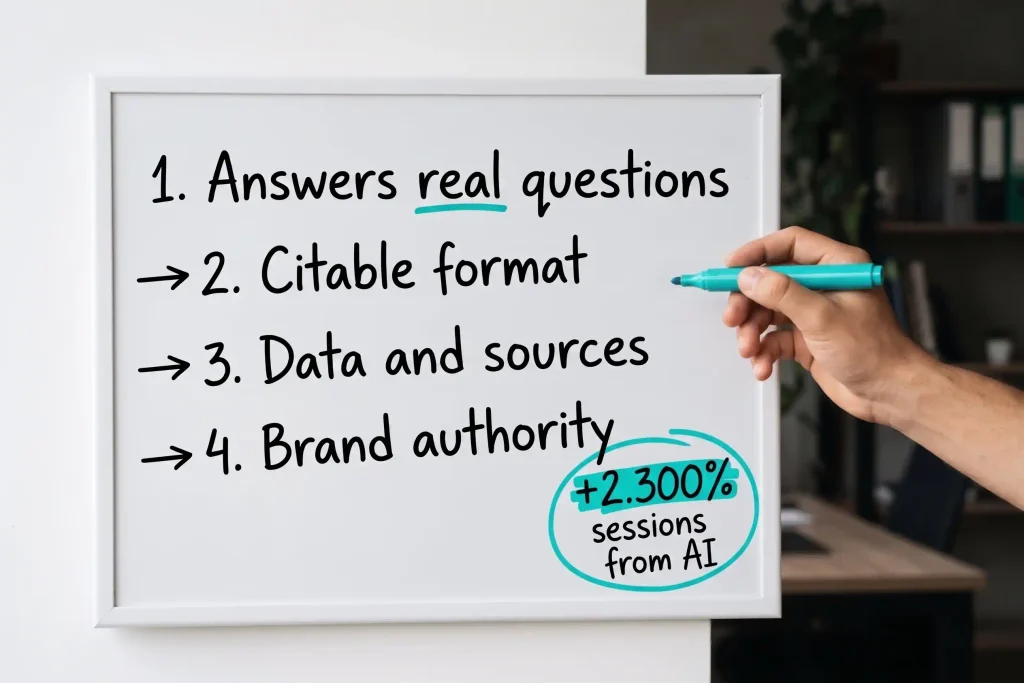
That is how we approached it for Hotel Regatta Cartagena, one of our case studies. By running SEO, GEO and paid media under one plan, sessions from AI assistants grew 2,300% in June to August 2026 compared with the same period in 2025. The quarter brought 120 sessions, 110 of them from ChatGPT, and the hotel’s organic traffic grew 3.5x over the previous quarter.
Common mistakes that keep you out of AI answers
- Blocking AI bots by default: some CDNs and security plugins do it silently. Recheck the settings after every hosting change.
- Inconsistent details: an old phone number in one directory or a different address on Google Business Profile weakens trust in the whole entity.
- Generic content: copy that could belong to any competitor gives the assistant nothing worth citing.
- Tracking Google rankings only: you can hold a top 3 spot and still be missing from every AI answer. They are separate measurements.
- Expecting results in weeks: changes to off-site mentions and entity signals take time to surface. Plan in quarters.
Frequently asked questions
How long does it take for a business to show up in ChatGPT or Gemini answers?
Technical fixes, like unblocking crawlers or correcting business details, can show up within weeks. Off-site mentions and topical authority usually take three to six months to appear consistently in your prompt panel.
Can I pay to have ChatGPT or Gemini recommend my business?
Organic recommendations from AI assistants are not for sale. When a platform shows ads, they are labeled and kept apart from the answer. Getting into the answer itself takes the entity, mentions and content work covered in this guide.
Does GEO replace SEO?
GEO is built on top of SEO. Assistants use Google and Bing indexes for live search, so a site without solid technical SEO has little chance of being cited.
Does GEO work for local businesses like hotels, restaurants or real estate agencies?
Yes, and local businesses often see results first. Local queries such as “where to stay”, “where to eat” or “who sells homes in” lean heavily on Google Business Profile, reviews and city guides, all sources a business can improve quickly.
Get your GEO assessment
At Digisap we check whether AI assistants already mention your business, which sources they cite for your competitors and what is holding back your visibility. You get a prioritized plan showing what to fix first. Request your GEO assessment.