

For hotels and restaurants, investing in digital marketing is no longer the main challenge. In 2026, the real differentiator is knowing whether that investment is actually generating revenue, bookings, and sustainable profitability, or if it is only producing clicks and interactions with no real business impact.
General managers, marketing directors, and business owners often receive reports full of metrics, but few provide a clear answer to a critical question: what is the real return on our advertising spend? This is where properly measuring ROAS (Return on Ad Spend) becomes essential.
From Digisap’s experience as a digital marketing agency and growth partner specialized in hospitality, gastronomy, and real estate across Colombia, Mexico, and the United States, we have seen that when ROAS is measured and interpreted correctly, marketing stops being an expense and becomes a true growth engine.
This article explains how to measure ROAS in digital campaigns for hospitality and gastronomy, which KPIs should support it, how to read dashboards correctly, and how to use this data to increase direct bookings, qualified leads, and profitability.
TL;DR
- ROAS measures the revenue generated by each dollar invested in ads.
- In hotels and restaurants, cancellations, no-shows and commissions must be deducted.
- ROAS should be analyzed together with ROI and business margin.
- At Hotel Regatta Cartagena, Google Ads reached a ROAS of 4.61.
Key benefits of measuring ROAS correctly
Implementing proper ROAS measurement in hospitality and gastronomy delivers clear, measurable benefits:
- Better investment decisions, based on real revenue rather than vanity metrics.
- Increased direct bookings, by prioritizing the channels with the highest return.
- Budget optimization, reducing spend on underperforming platforms or campaigns.
- Greater control over growth, with predictable sales and occupancy.
- Reduced dependence on OTAs and intermediaries, by comparing their real cost versus direct acquisition.
Investing in specialized digital marketing is not an expense—it is a strategy to improve ROAS and long-term profitability.
How ROAS measurement works in digital campaigns
Investment and expected return (ROAS and ROI)
ROAS shows how much revenue is generated for every unit of advertising spend.
Example:
- Investment: $1,000
- Attributed revenue: $5,000
- ROAS: 5x
In hospitality and gastronomy, this calculation requires additional care due to:
- cancellations,
- no-shows,
- commissions,
- offline sales.
For this reason, ROAS must always be analyzed alongside ROI and net margin.
| Concept | What it measures | Watch out for |
|---|---|---|
| ROAS | Revenue per dollar invested in ads | Cancellations, no-shows and commissions |
| ROI | Profitability after all costs | Operating and team costs |
| Cost per booking or lead | What each conversion costs | Lead or booking quality |
Key channels: SEO, SEM, social ads, and automation
Accurate ROAS measurement considers the full funnel:
- SEO and local GEO strategies to capture high-intent demand.
- SEM (Google Ads) to activate immediate bookings.
- Social ads (Meta, TikTok) to generate interest and support remarketing.
- Email and automation to increase repeat business and reduce acquisition costs.
Not all channels should be expected to deliver the same ROAS. The objective defines the acceptable return.
Technology and measurement: analytics and dashboards
To measure real ROAS, businesses must properly integrate:
- Google Analytics (GA4)
- Google Tag Manager
- Booking engines or POS systems
- CRM platforms
- Advertising platforms
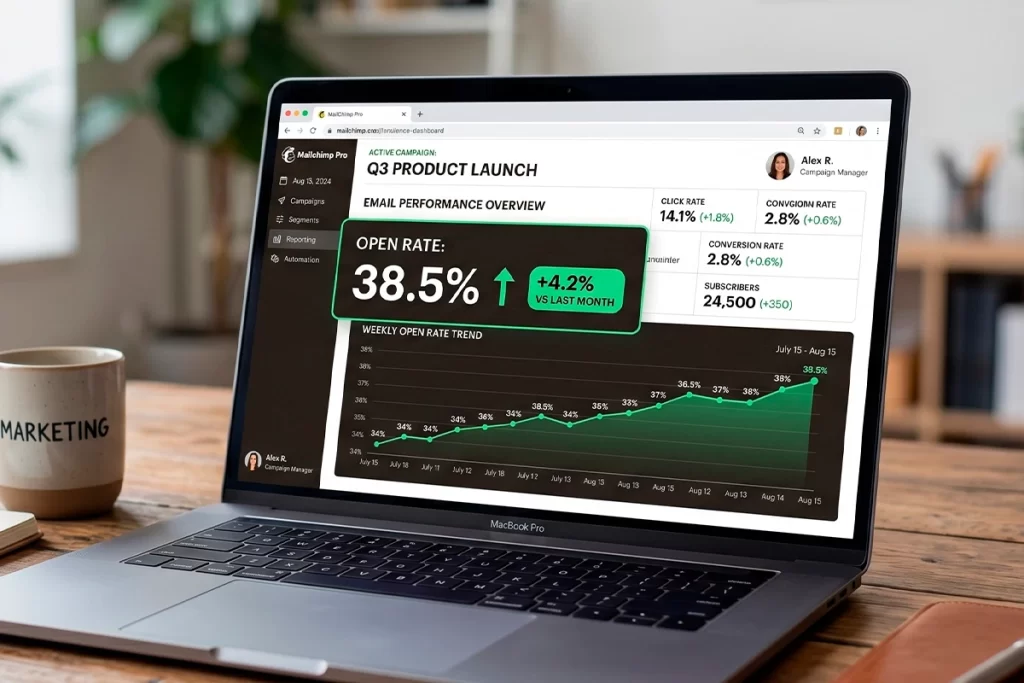
An effective marketing dashboard should clearly show:
- investment versus revenue,
- ROAS by channel,
- bookings or leads generated,
- weekly and monthly trends.
Fewer metrics, better decisions.

Team, support, and implementation timelines
The right growth partner does more than deliver reports.
They support the business in:
- interpreting data,
- making strategic decisions,
- adjusting campaigns,
- scaling results over time.
At Digisap, we believe marketing should adapt to the business model—not the other way around.
Real cases and an illustrative example
Hotel Regatta Cartagena: 4.61 ROAS on Google Ads
At Hotel Regatta Cartagena we measure each channel by its real contribution to bookings. As a result, between June and August 2026 Google Ads reached a ROAS of 4.61, while organic traffic multiplied by 3.5 (+253%). See the Hotel Regatta case.
El Cielo Hotel: premium ROAS and more direct sales
At El Cielo Hotel the focus was direct sales. As a result, sales doubled with a premium ROAS, the direct channel reached 32% of the total and the booking engine went from 7% to 24.2%. See the El Cielo Hotel case.
Hypothetical example: platform ROAS vs. real ROAS
Imagine a boutique hotel whose Google Ads dashboard shows a high ROAS. However, once bookings are cross-checked against cancellations, no-shows and commissions, the effective ROAS turns out much lower. That is why measurement should rely on real revenue, not only on what each platform reports. This example is illustrative: the result depends on each business.
Specialized digital marketing as a competitive advantage
A well-measured digital strategy allows hotels, restaurants, and real estate projects to:
- compete with large chains,
- position themselves in key tourism markets such as Medellín, Cartagena, Miami, or Orlando,
- attract international customers,
- scale revenue without proportional cost increases.
Proper ROAS measurement turns marketing into a strategic management tool, not just a promotional channel.
Ongoing support, measurement, and optimization with Digisap
At Digisap, we operate as a growth partner through a clear process:
- Initial business and market analysis.
- Definition of KPIs aligned with revenue and profitability.
- Implementation of SEO, paid media, content, and automation.
- Continuous testing and optimization.
- Clear reports and executive dashboards.
Our approach combines close support, agility, continuity, and a strong focus on real metrics such as ROAS, bookings, and qualified leads.
Want to measure and improve your ROAS?
If you manage a hotel, restaurant, or real estate project and want to make decisions based on real data, the next step is to evaluate your current measurement setup.
Learn more about our plans and request a personalized consultation at
Frequently asked questions (FAQ)
What is ROAS and why is it critical in hospitality and gastronomy?
ROAS measures how much revenue is generated for each unit invested in digital marketing and helps evaluate real campaign profitability.
How often should ROAS be analyzed?
Weekly for active campaigns and monthly for strategic decision-making.
What is a healthy ROAS?
It depends on margins. The key is to calculate your break-even ROAS: the minimum that covers ad spend, commissions and margin.
Can platform-reported ROAS be trusted?
It is useful for tactical optimization, but must be adjusted with real business data for strategic decisions.
Knowing how to measure ROAS in digital campaigns for hospitality and gastronomy is now a competitive advantage. It enables smarter investment, reduced dependence on intermediaries, and scalable growth with control and predictability.
Digital marketing stops being an expense when it is measured, understood, and optimized strategically. In that process, Digisap acts as a growth partner that supports, measures, and optimizes to drive real business results.